31 Mar New Sefiani research — AI has rewired brand reputation and discovery, but who’s accountable?
AI search has become the front door to brand reputation. When buyers, customers, journalists, and internal stakeholders ask ChatGPT, Gemini, Perplexity or Google’s AI surfaces to “compare providers” or “recommend the best option,” the answer they get increasingly shapes what they believe and what they do next.
The challenge is, AI doesn’t experience your brand in the neat channels that have been defined by decades of siloed marketing and communications activity. Instead, Ii reads across everything: earned media coverage, on-site content, social signals, search authority, analyst commentary, even historical content that brands and their stakeholders may have forgotten.
This is the issue many organisations are now running into: AI visibility is crucial from a reputation perspective, but no one team clearly owns, or understands how to influence, it. In other words, the GEO (Generative Engine Optimisation) can is being kicked down the road and won’t be prioritised until it’s too late.
The ownership vacuum is creating risk
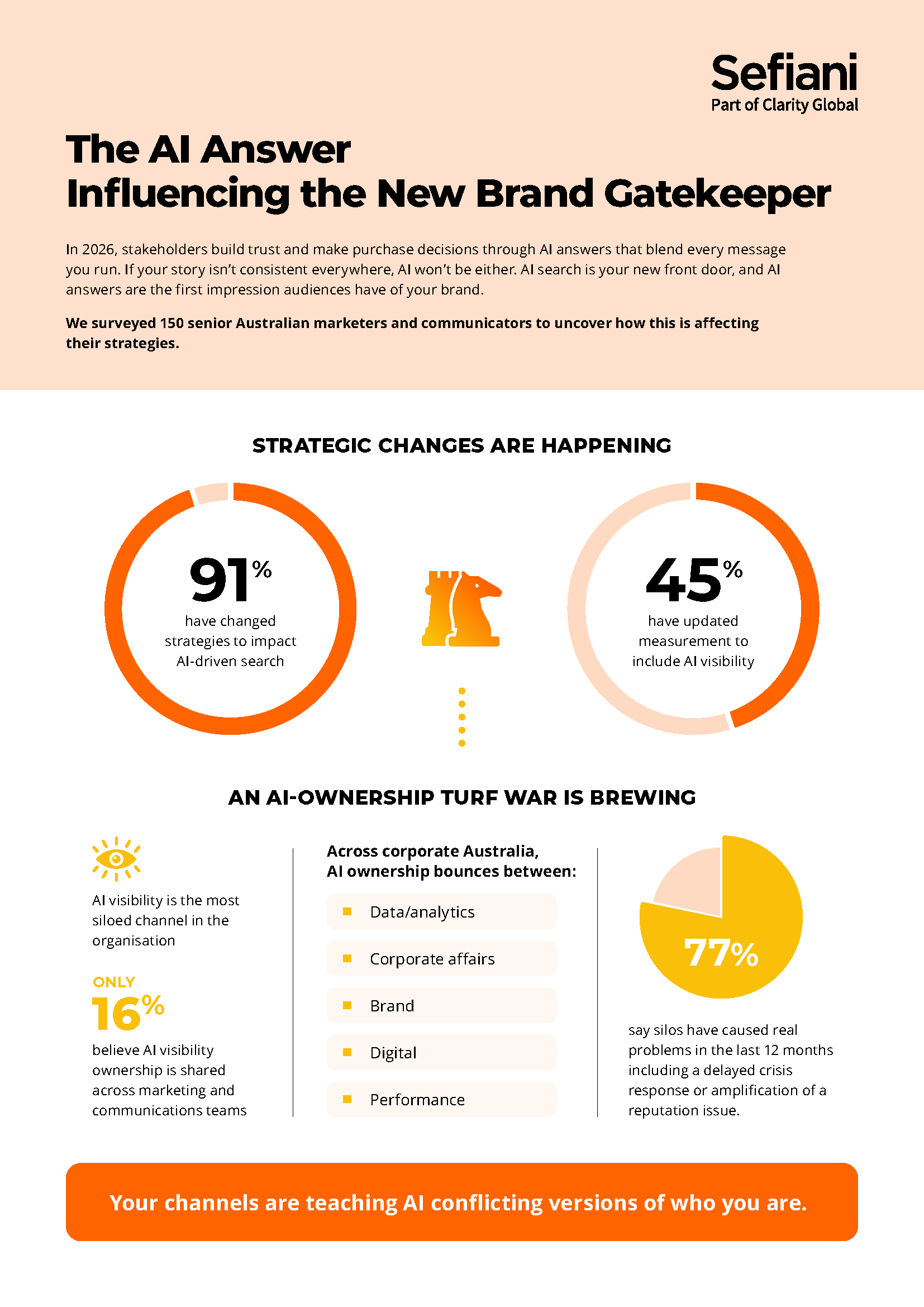
Sefiani, part of Clarity Global recently surveyed 150 senior marketing and communications leaders, and the results are telling: while 91% are changing strategies to account for AI-driven discovery, 84% disagree on who ‘owns’ AI visibility within the organisation.
For this cohort, ownership currently bounces between five functions including Data/Analytics (23%), Comms/Corporate Affairs (20%), Brand (19%), Digital (17%) and Performance (16%). This means that most organisation’s approach to AI visibility is structurally fragmented, and likely lacks clear leadership.
This lack of ownership, and more importantly leadership, will prevent GEO progress. Why? Because GEO success requires a unified message across channels, which demands integrated teams.
Cross-departmental silos are driving brand risk
At Sefiani’s recent GEO executive dinner, and a high-profile panel at Mumbrella CommsCon moderated by Mandy Galmes, Managing Partner at Sefiani with Johanna Lowe, Chief Marketing and Communications Officer at the University of Sydney; Brad Pogson, Head of Communications at Lendi Group; and Tom Telford, Chief Digital Officer at Clarity Global as speakers, a key theme emerged. Marcomms leaders are seeing AI as a “shadow task” layered onto already overloaded senior roles, with no clear mandate, no single integrated roadmap, and no agreed measurement model.
Our research corroborates this: more than two-thirds (77%) of CMOs and CCOs haven’t yet updated measurement processes to account for AI surfaces, which makes prioritisation harder and budget battles more likely.
But the most urgent consequence comes back to risk. Leaders report that siloed approaches have already caused real problems for their organisation: slower responses to issues, conflicting messages across channels, and AI tools amplifying yesterday’s narrative instead of today’s. What’s more is one in four say they’ve already seen incorrect, inconsistent, or outdated brand information appear in AI answers.
There’s also a uniquely AI-era twist on reputational exposure: historical persistence. Unlike traditional search (where old pages may fade into irrelevance), large language models (LLMs) can resurface patterns across years. This means unresolved issues, legacy messaging, or outdated product claims can reappear as if they’re current.
In short, silos, and a lack of insight into AI visibility, is creating a new category of reputational vulnerability too.
What getting GEO right looks like
GEO shouldn’t be seen as a new channel to be bolted on, requiring a fresh team. Instead, it’s a strategic layer connecting everything marketing and communications are already doing, and it requires the organisation to move in sync.
From our GEO work with clients, three factors consistently move the needle:
- Consistent narratives: the brand must be described in the same way across all channels: your website, earned coverage, social, and spokespeople narratives so AI receives a clear, repeated signal.
- Authority of source: AI is more likely to trust and repeat information that comes from credible, relevant, frequently cited sources (including quality trade publications and analyst content).
- Structured content: AI models do not discriminate by content format, but they do reward depth. Insights suggest that high-quality, thought leadership content performs better within LLM training sets so will need to be central to strategies across channels moving forward.
These outcomes require coordination between comms, social, content, marketing, and technical/SEO, with shared priorities, shared language, and shared accountability.
If there’s one practical takeaway for leaders from our research and qualitative insight, it’s that GEO needs integration by design, not goodwill. That means establishing a cross-functional operating model that aligns objectives, budgets, people and KPIs across teams.
Getting started with GEO
While GEO is seemingly a new and abstract concept, it doesn’t have to be complicated.
At Sefiani and Clarity Global, we’ve launched a global GEO consultancy that combines reputation expertise with a practical, cross-functional approach helping organisations break silos and build a consistent narrative that AI (and its users; your stakeholders) can trust.
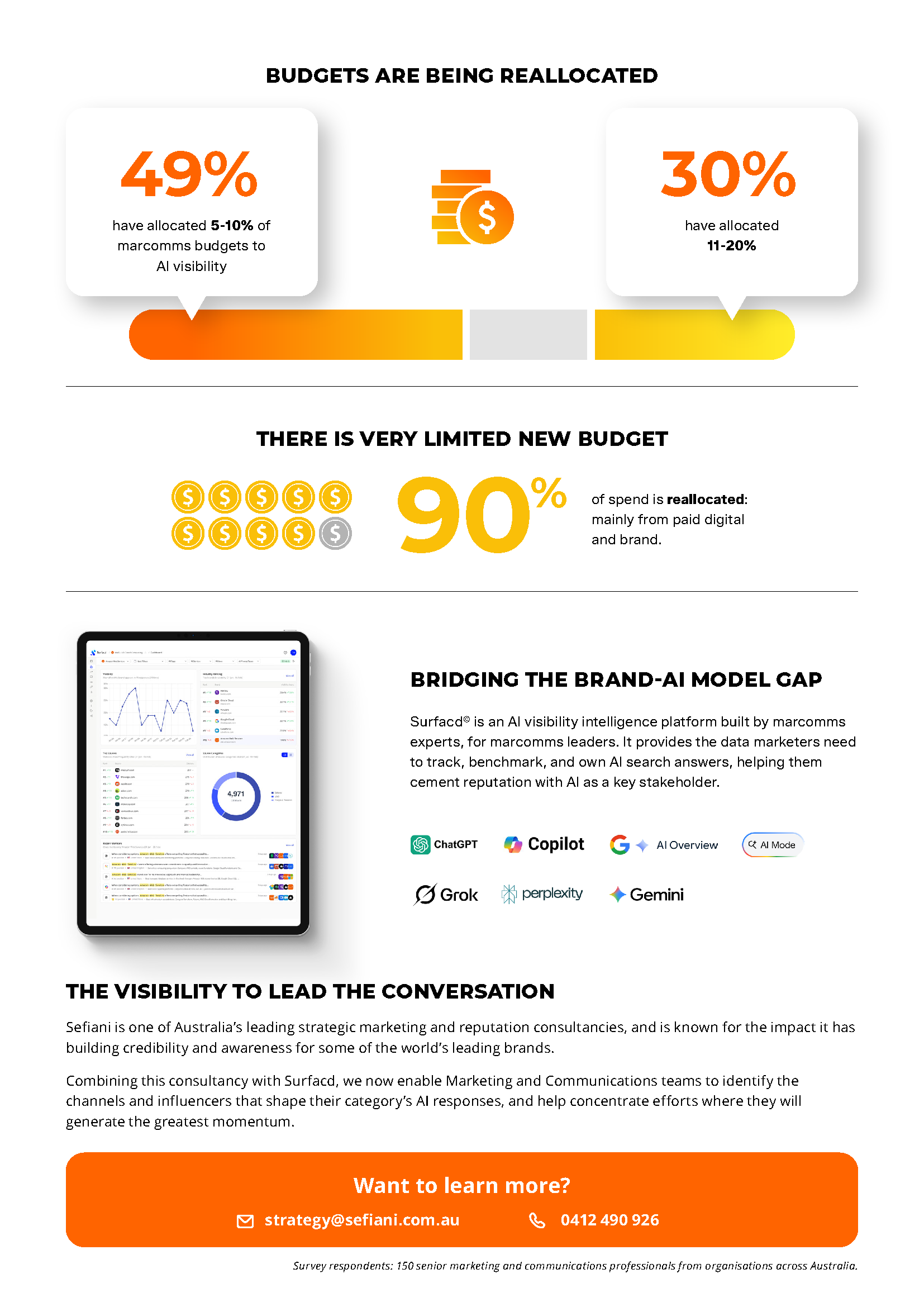
We’ve also developed Surfacd, our proprietary AI visibility platform, that tracks how brands are positioned and recommended across major AI platforms, benchmarks competitors, and crucially, identifies the citations and sources shaping AI answers.
This insight layer enables smarter decisions about what to fix, what to amplify, and where to focus effort so that GEO becomes a strategic multiplier on the work you’re already investing in.
Talk to us
If you’re interested in learning more about Sefiani’s GEO services, or setting up a free Surfacd demo, drop us a line via [email protected].